X2Power#

Created by ASVA Consulting
asvaconsulting.com
contacto@asvaconsulting.com
Feedstock-to-electricity simulation in Python.
Owned, created and maintained by ASVA Consulting, X2Power models combustion, gasification, pyrolysis, anaerobic digestion, organic wastewater and biogas generation. It exposes the assumptions behind gross and net electricity, process heat, auxiliary loads, generator capacity and availability.
AI-assisted development and literature basis#
Most of the code, documentation, examples, tests and repository scaffolding are AI-generated under developer direction, based on real, specifically identified scientific and technical literature selected by the repository developers.
Developers choose the references used to define physical assumptions, methods and parameter conventions. AI assists with implementation, documentation, testing and iteration around that evidence base. Developers and contributors remain responsible for source selection, review, testing and scientific validation.
AI-generated code and explanations may contain errors or imperfect interpretations of the selected sources. Automated tests establish numerical consistency; they do not establish empirical accuracy. Validation is still developing. The original route scenarios and continuous-plant presets are synthetic illustrative inputs. Source-backed analyses separately identify published measurements, assumptions and simulated results; cited laboratory data do not validate plant performance.
Trace assumptions through the model references, biogas plant references and plastic example boundaries. See verification and calibration for the evidence available and the checks needed before interpreting results as equipment predictions.
Start here#
User guide: install the package and run a first simulation.
Example gallery: execute worked examples and inspect their figures.
API reference: explore inputs, methods and utilities generated from Python code.
Model equations: understand energy boundaries, units and physical limitations.
Continuous biogas plants: mixed feeds, substrate inventories, gas storage, CHP outages, process heat and grid imports/exports.
Plastic to electricity: a worked pyrolysis example with process heating, auxiliary consumption and generator-capacity sensitivity.
Tenerife banana residues: source-backed electricity screening with separate grid imports/exports, cost-benefit methods and reproducible financial sensitivities.
What can you simulate?#
Input |
Method |
Main outputs |
|---|---|---|
Biomass or plastic |
Combustion, gasification or pyrolysis |
Selected fuel energy, drying duty, electricity and heat |
Food waste or sludge |
Volatile-solids digestion |
Methane production, capture and electricity |
Organic wastewater |
Removed-COD methane yield |
COD removal, biogas and electricity |
Biogas |
Methane-fraction generator model |
Gross/net electricity and usable heat |
The simulation core uses the Python standard library. Optional Matplotlib support provides electricity/heat breakdowns, operating profiles, sensitivity curves and uncertainty figures.
Explicit assumptions#
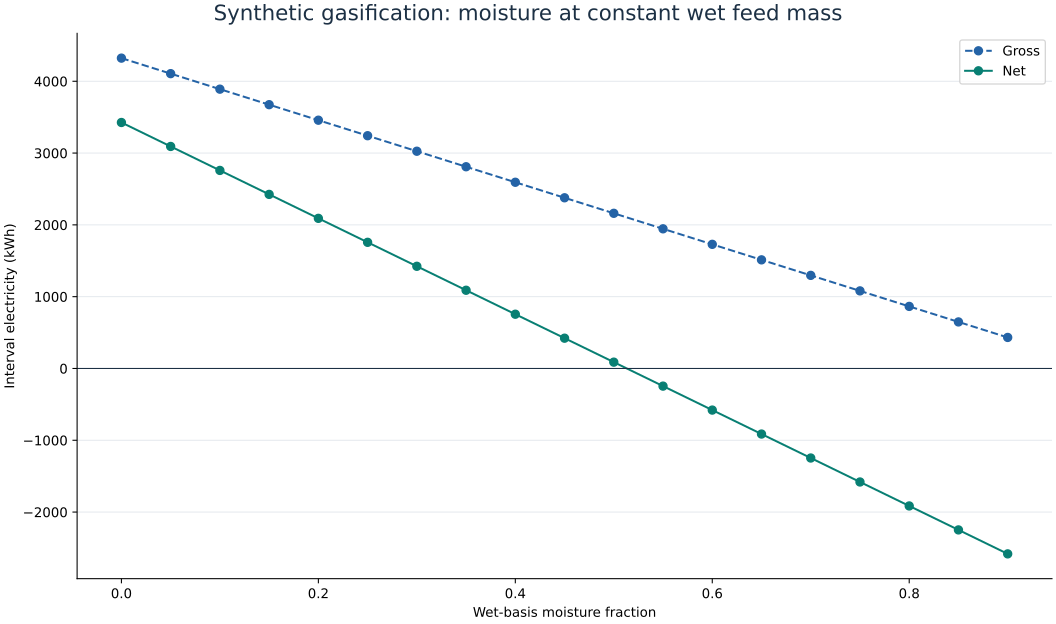
These are reduced-order, interval-based models with constant efficiencies. Example assumptions require calibration. Negative net electricity is retained: it represents an external electrical requirement. The energy residual checks the generator boundary, not a complete upstream reactor balance.
See validation guidance before interpreting numerical output as a prediction for specific equipment.
License#
Copyright (c) 2026 ASVA Consulting TFE SL. Original software is source-available for noncommercial use only. Commercial use, including internal business use and paid services, is prohibited under the project license. Third-party materials retain their own terms; see licensing scope.