SpaceX-inspired orbital compute#
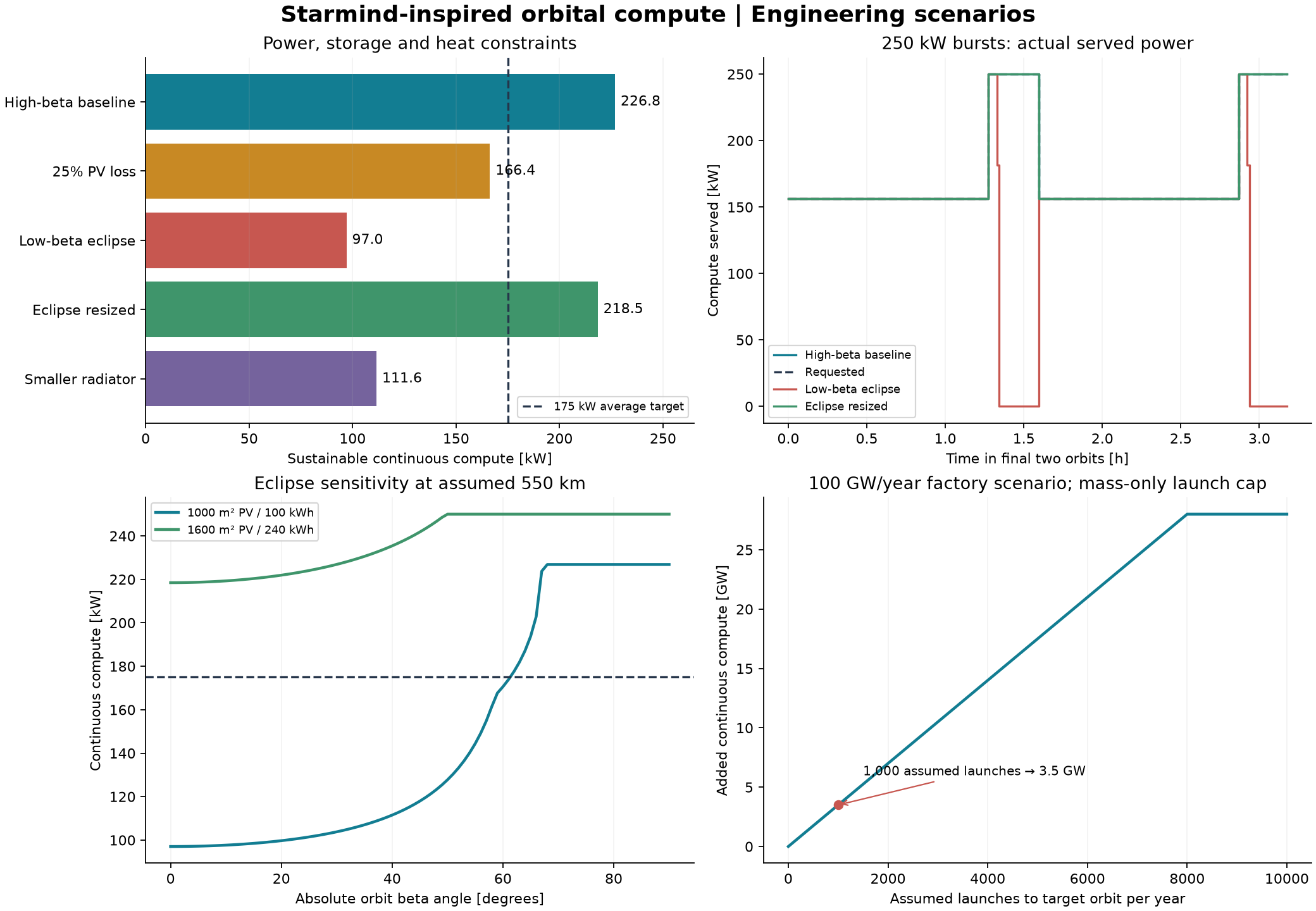
The Starmind example connects a news-motivated HJT manufacturing scenario to solar generation, eclipse storage, radiative cooling and deployment throughput. Its 175 kW average and 250 kW peak targets are SpaceX design claims. All other hardware, orbit and launch inputs are explicit analyst assumptions.
Run and inspect#
Install the current source checkout, then run:
python -m pip install -e ".[examples]"
python analysis/spacex_starmind/run.py --output outputs/spacex_starmind
python examples/space_business/plot_spacex_starmind.py
The runner accepts --input for a modified JSON configuration. It writes
scenario summaries, interval dispatch, beta-angle/area sensitivity, launch
sensitivity and complete input provenance. It requires no network requests.
See the runnable gallery and full analysis, evidence, equations and reference results.
What the result means#
The assumed illuminated baseline serves the full burst schedule. Reducing PV output, entering a low-beta eclipse orbit, or reducing radiator area can make the target infeasible. The model distinguishes continuous service from the time-average of intermittent compute and explicitly reports platform outages when an overloaded greedy schedule depletes storage.
Manufacturing nameplate watts use an explicitly assumed STC basis; orbital bus power uses a separately assumed AM0 efficiency. Added usable compute is then limited by complete-spacecraft mass and assumed launch throughput. Factory capacity is neither deployed power nor AI workload throughput.
The thermal model uses total emitting area and a prescribed radiator temperature with a validated EPS/storage heat allowance. It does not establish junction temperature feasibility. The eclipse model samples fixed representative beta angles, not an annual SSO ephemeris. No SpaceX operational performance or deployment forecast is implied.