Note
Go to the end to download the full example code.
Plastic to electricity: pyrolysis, heat and net power#
Follow a synthetic 2-tonne plastic-containing feed through a lumped pyrolysis stage and a generator over 24 hours. Three figures explain the electrical and thermal balance, fuel-recovery sensitivity, and the effect of generator capacity. These inputs are illustrative, not measured performance or equipment guarantees.
from x2power.scenario import run_scenario
from x2power.utilities.experiments import sweep_parameter
from x2power.utilities.plotting import plot_energy_balance, plot_sensitivity
1. Specify the feed and conversion assumptions. The 40 MJ/kg lower heating value is per kg of dry feed. With 2% moisture, 2000 kg wet feed contains 1960 kg dry material and 40 kg water. Selected pyrolysis fuel products carry 70% of the dry-feed chemical energy before the explicitly modelled process heat demand. Product gas/oil/char mass yields and fuel-engine compatibility are not predicted.
The dictionary is self-contained so the downloaded Python/notebook runs without
input files. It uses the same inputs as scenarios/plastic_pyrolysis.json.
scenario = {
    "schema_version": 1,
    "duration_h": 24.0,
    "availability": 0.95,
    "description": "Synthetic illustrative parameters; not measured equipment performance.",
    "name": "plastic_pyrolysis",
    "generator": {
        "electrical_efficiency": 0.35,
        "heat_recovery_efficiency": 0.4,
        "rated_power_kw": 500.0,
    },
    "auxiliaries": {
        "fixed_power_kw": 3.0,
        "electricity_fraction_of_gross": 0.04,
        "process_electricity_kwh": 20.0,
        "electric_heater_efficiency": 0.95,
        "process_heat_usable_fraction": 0.0,
    },
    "route": "pyrolysis",
    "feedstock": {"mass_kg": 2000.0, "moisture_fraction": 0.02, "dry_lhv_mj_per_kg": 40.0},
    "process": {
        "fuel_energy_recovery": 0.7,
        "evaporation_heat_kwh_per_kg_water": 0.75,
        "process_heat_kwh_per_kg_dry": 0.6,
    },
}
2. Convert the selected fuel in a 500 kW gross generator, with 35% electrical efficiency and 95% availability. Pyrolysis and drying heat are supplied by an electric heater. Recovered generator heat is deliberately not credited to the high-temperature process: temperature suitability/integration is unverified. Pumps, preparation and other auxiliaries are represented by the declared loads.
result = run_scenario(scenario)
power = result.power
print(f"Dry-feed chemical energy: {result.metrics['feedstock_chemical_energy_kwh']:,.1f} kWh")
print(f"Selected fuel energy: {power.fuel_energy_available_kwh:,.1f} kWh")
print(f"Unused selected fuel: {power.unused_fuel_energy_kwh:,.1f} kWh")
print(f"Gross electricity: {power.gross_electricity_kwh:,.1f} kWh")
print(f"Process heat demand: {power.process_heat_demand_kwh:,.1f} kWh thermal")
print(f"Heater electricity: {power.electric_heating_kwh:,.1f} kWh")
print(f"Auxiliary electricity: {power.auxiliary_electricity_kwh:,.1f} kWh")
print(f"Net electricity: {power.net_electricity_kwh:,.1f} kWh over 24 h")
print(f"Average net power: {power.net_power_kw:,.1f} kW")
wet_tonnes = scenario["feedstock"]["mass_kg"] / 1000
print(f"Net per wet tonne: {power.net_electricity_kwh / wet_tonnes:,.1f} kWh/t")
Dry-feed chemical energy: 21,777.8 kWh
Selected fuel energy: 15,244.4 kWh
Unused selected fuel: 762.2 kWh
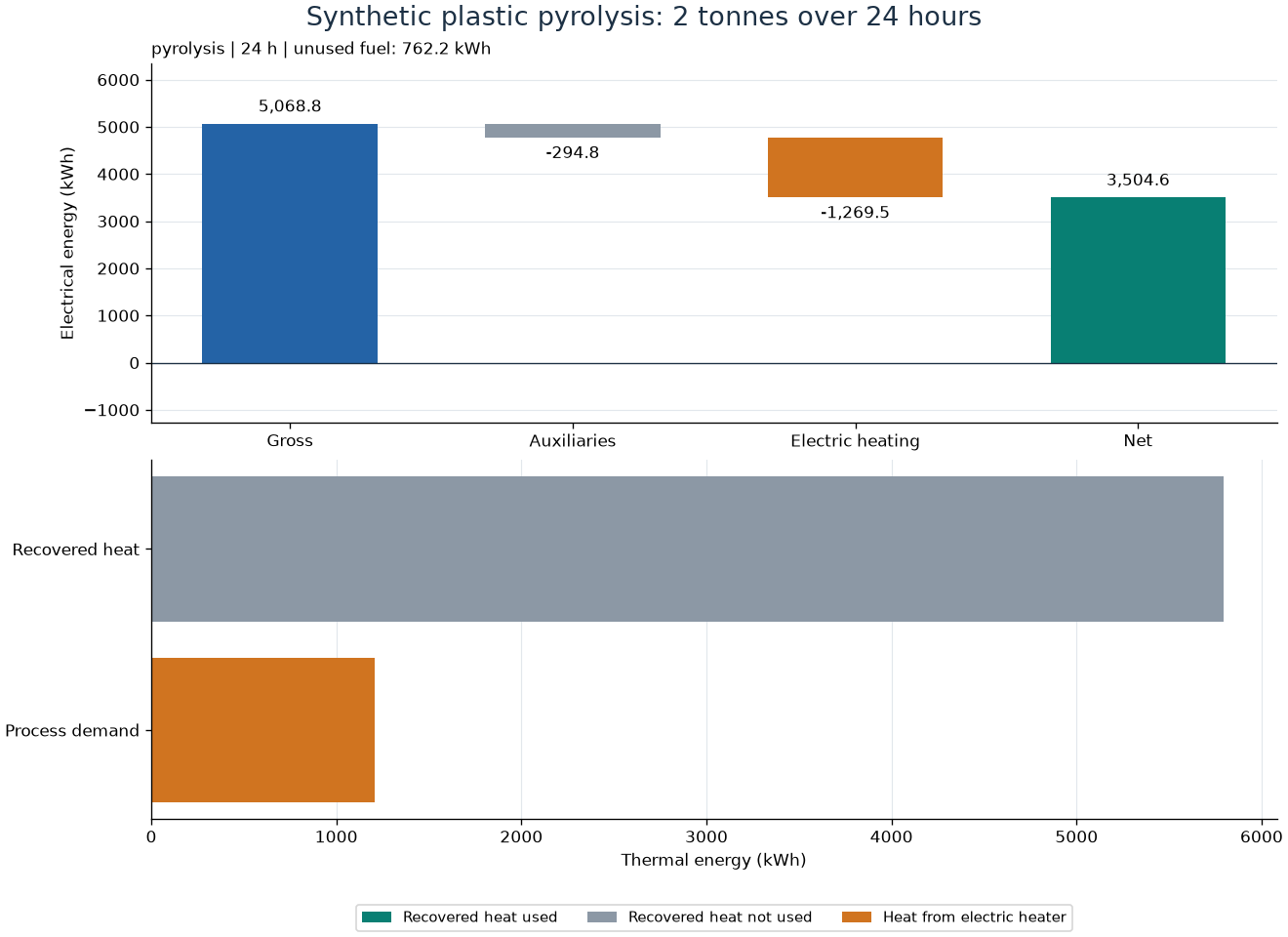
Gross electricity: 5,068.8 kWh
Process heat demand: 1,206.0 kWh thermal
Heater electricity: 1,269.5 kWh
Auxiliary electricity: 294.8 kWh
Net electricity: 3,504.6 kWh over 24 h
Average net power: 146.0 kW
Net per wet tonne: 1,752.3 kWh/t
3. Inspect the electricity waterfall and heat allocation. Heater electricity exceeds delivered heat because heater efficiency is 95%. Recovered heat that cannot serve this process is shown separately and is not counted as electricity. Unused fuel from unavailable/capacity-limited hours is reported without assuming storage, flaring or a particular product destination.
balance_figure = plot_energy_balance(
    result, title="Synthetic plastic pyrolysis: 2 tonnes over 24 hours"
)
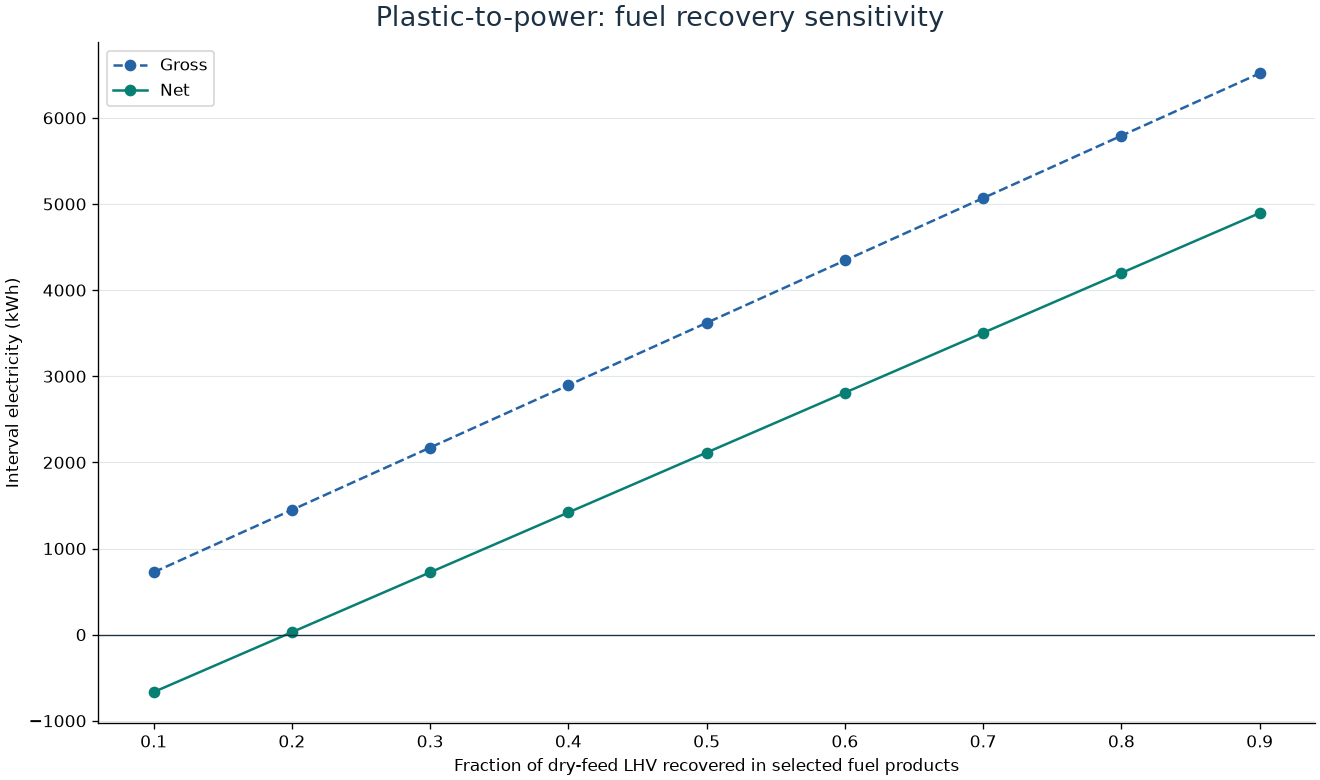
4. Vary only fuel-energy recovery. These wide stress-test values are not an experimentally supported range. At low recovery, heating and auxiliary loads can exceed generation. Negative net output is retained as an electrical import requirement. All other inputs, including the heater load, remain fixed.
recovery = sweep_parameter(scenario, "process.fuel_energy_recovery", [i / 10 for i in range(1, 10)])
recovery_figure = plot_sensitivity(
    recovery,
    xlabel="Fraction of dry-feed LHV recovered in selected fuel products",
    title="Plastic-to-power: fuel recovery sensitivity",
)
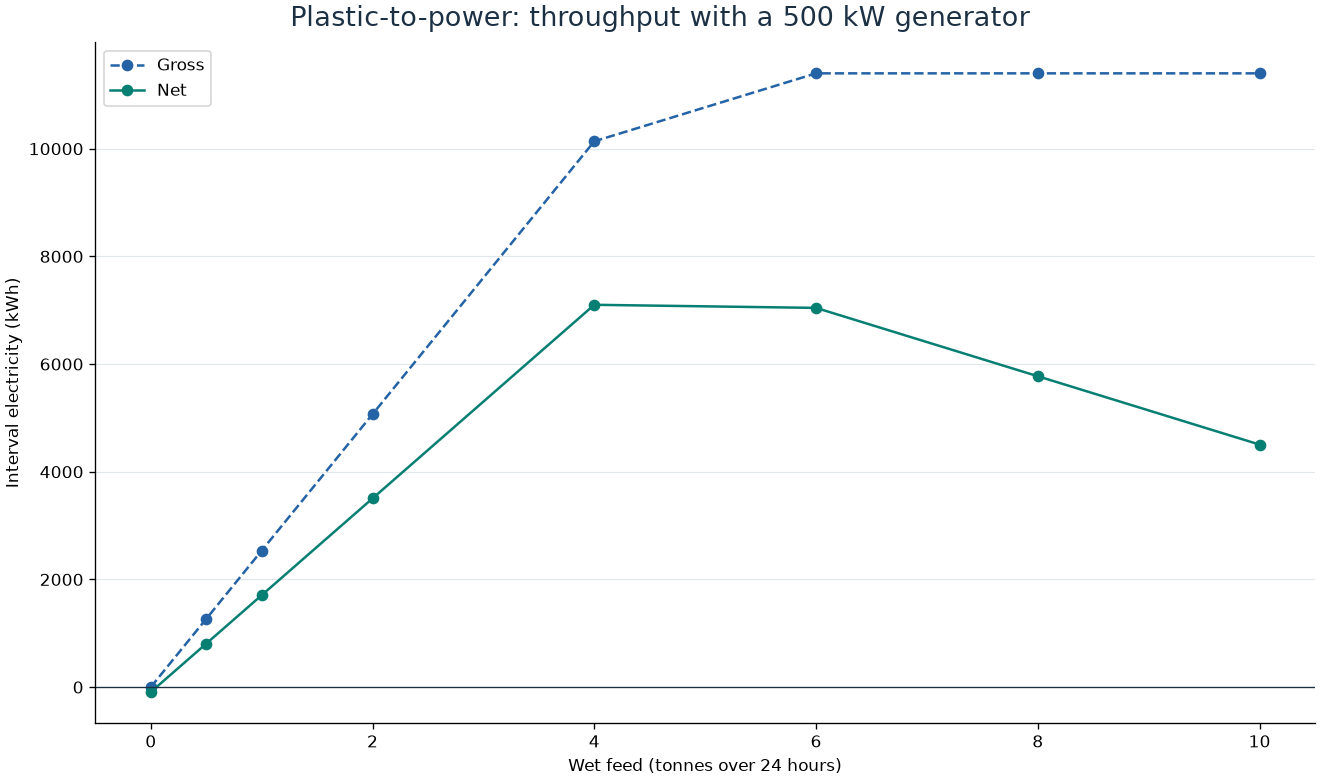
5. Vary wet throughput at the same moisture and LHV. Gross generation eventually reaches the 500 kW rating times 24 hours times 95% availability. Heating scales with processed feed, so adding feed beyond generator capacity need not improve net electricity. Fixed loads and the 20 kWh interval process load remain fixed; the percentage auxiliary load follows gross generation. No reactor capacity constraint or automatic feed reduction is assumed.
throughput = sweep_parameter(
    scenario, "feedstock.mass_kg", [0, 500, 1000, 2000, 4000, 6000, 8000, 10000]
)
throughput_figure = plot_sensitivity(
    [{**row, "input_value": row["input_value"] / 1000} for row in throughput],
    xlabel="Wet feed (tonnes over 24 hours)",
    title="Plastic-to-power: throughput with a 500 kW generator",
)
6. Check the generator energy ledger. This residual does not validate upstream chemistry or the assumed yields. Actual plastic composition, contamination, preparation, product conditioning, generator compatibility and emissions need separate data and models. Do not interpret these assumptions as a universal result for mixed plastics or as a detailed reactor design.
print(f"Generator energy residual: {power.balance_residual_kwh:.3e} kWh")
maximum_gross = max(row["gross_electricity_kwh"] for row in throughput)
print(f"Maximum gross electricity in sweep: {maximum_gross:,.1f} kWh")
Generator energy residual: 0.000e+00 kWh
Maximum gross electricity in sweep: 11,400.0 kWh
Total running time of the script: (0 minutes 0.282 seconds)