Note
Go to the end to download the full example code.
Mars orbital solar-array pointing reserve#
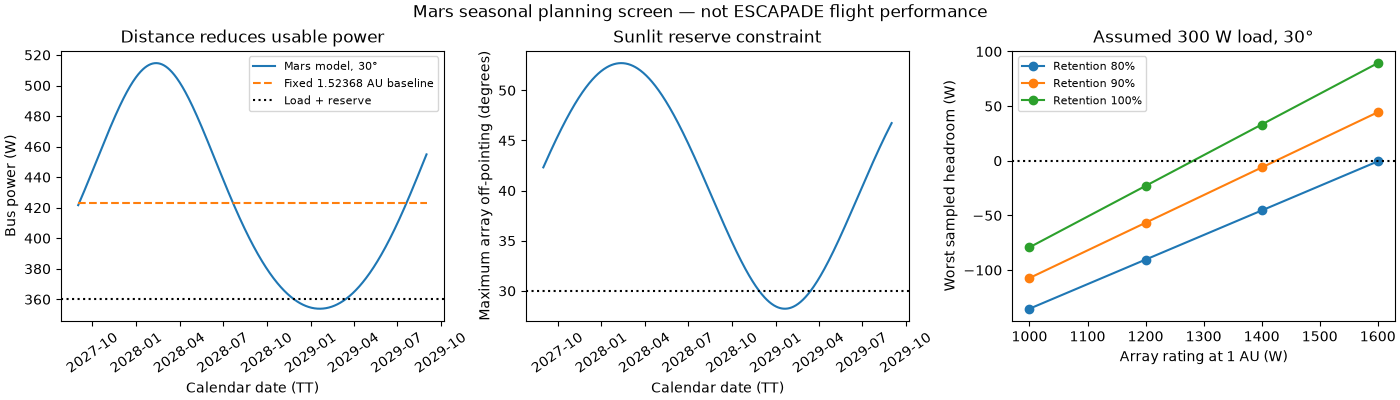
NASA’s November 9, 2026 ESCAPADE flyby update motivates a Mars mission power planning screen. Can an assumed 1.4 kW array (at 1 AU) support a 300 W bus, 20% reserve and 30 degree off-pointing throughout a two-year Mars campaign? NASA Mars24 seasonal distances and every power result are modeled. Array, retention, load and conversion inputs are illustrative, not ESCAPADE specs.
{
  "data_kind": "NASA Mars24 modeled geometry; assumed engineering inputs",
  "samples": 732,
  "distance_min_au": 1.3813599441143753,
  "distance_max_au": 1.6659818284619088,
  "worst_date_tt": "2029-01-20",
  "minimum_headroom_w": -6.16306363856819,
  "minimum_max_offpoint_deg": 28.223486985397113,
  "offpoint_infeasible_samples": 108,
  "required_array_1au_w": 1424.384930478773,
  "required_rating_increase_percent": 1.74178074848379,
  "required_rating_distance_stress_w": 1427.2351247246606,
  "fixed_mars_headroom_w": 63.01574114322335,
  "fixed_1au_headroom_w": 622.0728078915535,
  "sensitivity_cases": 36,
  "sensitivity_cases_passing_every_sample": 12
}
import json
from itertools import product
from pathlib import Path

import matplotlib.pyplot as plt
import numpy as np
import pandas as pd

from orbitalpv import ASTRONOMICAL_UNIT_M
from orbitalpv.environment import am0_irradiance
from orbitalpv.mars import mars_solar_parameters
from orbitalpv.physics import pointing_power_envelope


def configuration() -> dict:
    directory = Path(__file__).resolve().parent if "__file__" in globals() else Path.cwd()
    return json.loads((directory / "_data/mars_pointing.json").read_text())


def study() -> tuple[pd.DataFrame, pd.DataFrame]:
    config = configuration()
    # These are TT calendar labels, deliberately not UTC timestamps.
    dates = pd.date_range(config["start_tt"], config["stop_tt"], freq="D")
    distance = mars_solar_parameters(dates.to_julian_date().to_numpy())["sun_distance_au"]
    flux = am0_irradiance(distance * ASTRONOMICAL_UNIT_M)
    relative_flux = flux / am0_irradiance(ASTRONOMICAL_UNIT_M)
    normal = config["array_1au_w"] * config["retention"] * config["bus_efficiency"]
    frame = pointing_power_envelope(
        normal * relative_flux,
        config["load_w"],
        reserve_fraction=config["reserve_fraction"],
        offpoint_deg=config["offpoint_deg"],
    )
    frame["date_tt"] = dates
    frame["sun_distance_au"] = distance
    frame["am0_w_m2"] = flux
    frame["fixed_1au_offpoint_bus_w"] = normal * np.cos(np.deg2rad(config["offpoint_deg"]))
    frame["fixed_mars_offpoint_bus_w"] = frame.fixed_1au_offpoint_bus_w / 1.52367934**2
    frame["required_array_1au_w"] = frame.required_bus_w / (
        relative_flux
        * config["retention"]
        * config["bus_efficiency"]
        * np.cos(np.deg2rad(config["offpoint_deg"]))
    )
    rows = []
    for rating, retention, load in product(
        config["sensitivity_array_1au_w"],
        config["sensitivity_retention"],
        config["sensitivity_load_w"],
    ):
        case = pointing_power_envelope(
            rating * retention * config["bus_efficiency"] * relative_flux,
            load,
            reserve_fraction=config["reserve_fraction"],
            offpoint_deg=config["offpoint_deg"],
        )
        rows.append(
            {
                "array_1au_w": rating,
                "retention": retention,
                "load_w": load,
                "minimum_headroom_w": float(case.headroom_w.min()),
                "normal_infeasible_samples": int((~case.normal_feasible).sum()),
                "offpoint_infeasible_samples": int((~case.offpoint_feasible).sum()),
                "samples": len(case),
                "passes_every_sample": bool(case.offpoint_feasible.all()),
            }
        )
    return frame, pd.DataFrame(rows)


def metrics(frame: pd.DataFrame, sensitivity: pd.DataFrame) -> dict:
    config = configuration()
    worst = frame.loc[frame.headroom_w.idxmin()]
    required = float(frame.required_array_1au_w.max())
    return {
        "data_kind": "NASA Mars24 modeled geometry; assumed engineering inputs",
        "samples": len(frame),
        "distance_min_au": float(frame.sun_distance_au.min()),
        "distance_max_au": float(frame.sun_distance_au.max()),
        "worst_date_tt": str(worst.date_tt.date()),
        "minimum_headroom_w": float(worst.headroom_w),
        "minimum_max_offpoint_deg": float(frame.max_offpoint_deg.min()),
        "offpoint_infeasible_samples": int((~frame.offpoint_feasible).sum()),
        "required_array_1au_w": required,
        "required_rating_increase_percent": 100 * (required / config["array_1au_w"] - 1),
        "required_rating_distance_stress_w": required
        * (1 + config["distance_stress_fraction"]) ** 2,
        "fixed_mars_headroom_w": float(worst.fixed_mars_offpoint_bus_w - worst.required_bus_w),
        "fixed_1au_headroom_w": float(worst.fixed_1au_offpoint_bus_w - worst.required_bus_w),
        "sensitivity_cases": len(sensitivity),
        "sensitivity_cases_passing_every_sample": int(sensitivity.passes_every_sample.sum()),
    }


def plot_results(frame: pd.DataFrame, sensitivity: pd.DataFrame) -> plt.Figure:
    fig, axes = plt.subplots(1, 3, figsize=(14, 4), layout="constrained")
    axes[0].plot(frame.date_tt, frame.offpoint_bus_w, label="Mars model, 30°")
    axes[0].plot(
        frame.date_tt, frame.fixed_mars_offpoint_bus_w, "--", label="Fixed 1.52368 AU baseline"
    )
    axes[0].axhline(
        frame.required_bus_w.iloc[0], color="black", linestyle=":", label="Load + reserve"
    )
    axes[0].set(ylabel="Bus power (W)", title="Distance reduces usable power")
    axes[0].legend(fontsize=8)
    axes[1].plot(frame.date_tt, frame.max_offpoint_deg)
    axes[1].axhline(30, color="black", linestyle=":")
    axes[1].set(ylabel="Maximum array off-pointing (degrees)", title="Sunlit reserve constraint")
    for ax in axes[:2]:
        ax.tick_params(axis="x", rotation=35)
        ax.set_xlabel("Calendar date (TT)")
    selected = sensitivity[sensitivity.load_w == 300]
    for retention, group in selected.groupby("retention"):
        axes[2].plot(
            group.array_1au_w, group.minimum_headroom_w, "o-", label=f"Retention {retention:.0%}"
        )
    axes[2].axhline(0, color="black", linestyle=":")
    axes[2].set(
        xlabel="Array rating at 1 AU (W)",
        ylabel="Worst sampled headroom (W)",
        title="Assumed 300 W load, 30°",
    )
    axes[2].legend(fontsize=8)
    fig.suptitle("Mars seasonal planning screen — not ESCAPADE flight performance")
    return fig


if __name__ == "__main__":
    frame, sensitivity = study()
    print(json.dumps(metrics(frame, sensitivity), indent=2))
    plot_results(frame, sensitivity)
    plt.show()
Total running time of the script: (0 minutes 0.385 seconds)