Note
Go to the end to download the full example code.
Alberta: seven days of measured solar generation#
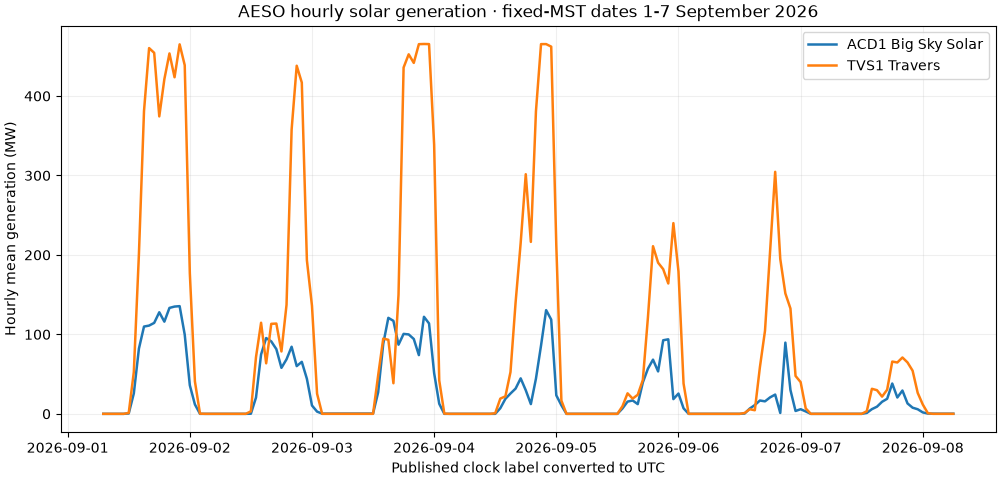
Read 336 real hourly observations for Big Sky and Travers solar from AESO’s public historical CSD Generation archive. The native CSV retains fixed-MST and MPT clock labels, output, capability, fuel and location fields. The gallery uses the public historical capture and needs no API key.
Source: AESO historical generation downloads.
Download the native CSV selection and
capture manifest.
import hashlib
import json
from pathlib import Path

import matplotlib.pyplot as plt

from energy_data_retrieval.sources.aeso import parse_generation_csv
1. Verify the original historical CSV rows#
The full public ZIP and extracted CSV are hashed in the manifest. The selected header and whole rows preserve original bytes, including CRLF line endings. For a new historical file, download a five-minute/hourly ZIP from AESO’s public archive, extract its native CSV, and use the bounded local importer:
from pathlib import Path
from energy_data_retrieval.sources.aeso import AESO_HOSTS, AESOClient
from energy_data_retrieval.transport import HTTPClient
with HTTPClient(AESO_HOSTS) as http:
    result = AESOClient(http).from_native_file(Path("CSD Generation (Hourly).csv"),
                                               interval_minutes=60)
The archive’s changing Box download redirects require this explicit download step. Local imports record a file hash and do not claim an HTTP request.
directory = Path(globals().get("__file__", Path.cwd() / "plot_generation_aeso.py")).resolve().parent
data = directory / "data"
manifest = json.loads((data / "generation_aeso_provenance.json").read_text())
raw = (data / manifest["fixture"]).read_bytes()
if hashlib.sha256(raw).hexdigest() != manifest["fixture_sha256"]:
    raise ValueError("AESO capture differs from its provenance")
frame = parse_generation_csv(raw.decode("utf-8-sig"), interval_minutes=60)
print("Source:", manifest["official_download_page"])
print("Captured:", manifest["retrieved_at_utc"], "native rows:", len(frame))
Source: https://www.aeso.ca/market/market-and-system-reporting/data-requests/historical-generation-data/
Captured: 2026-10-30T08:14:33.406021+00:00 native rows: 336
2. Keep net output, capability and clock conventions distinct#
Native Volume is average generation in MW over the chosen interval. Maximum Capability and System Capability are separate operating attributes. Source Date (MST) is fixed UTC-07 year round; the MPT label remains unchanged in the result, allowing autumn repeated civil hours to remain distinct.
print(
    frame.groupby("Asset Name").agg(
        observations=("value", "size"), reported=("value", "count"), peak_mw=("value", "max")
    )
)
                    observations  reported     peak_mw
Asset Name
ACD1 Big Sky Solar           168       168  135.536497
TVS1 Travers                 168       168  465.448052
3. Compare a complete week of source measurements#
Source labels are converted to UTC without asserting a start/end boundary. Missing readings remain gaps and negative net values are not clipped.
fig, ax = plt.subplots(figsize=(10, 4.8), layout="constrained")
for asset, profile in frame.groupby("Asset Name"):
    ax.plot(profile["timestamp"], profile["value"], label=asset, linewidth=1.8)
ax.set(
    title="AESO hourly solar generation · fixed-MST dates 1-7 September 2026",
    xlabel="Published clock label converted to UTC",
    ylabel="Hourly mean generation (MW)",
)
ax.grid(alpha=0.2)
ax.legend()
plt.show()
4. Acquire a current snapshot with an AESO subscription#
The separate current-generation API requires an AESO account/subscription key. This is a runnable acquisition recipe, not a captured authenticated response:
import os
with HTTPClient(AESO_HOSTS) as http:
    current = AESOClient(http).current_generation(
        api_key=os.environ["AESO_API_KEY"], asset_ids=["TVS1"])
The API key travels in a redacted secret header. The current endpoint returns net generation, capability and contingency reserve separately in MW; it does not supply historical intervals. Credit the Alberta Electric System Operator and follow AESO’s source reuse terms.
Total running time of the script: (0 minutes 0.111 seconds)