Note
Go to the end to download the full example code.
Great Britain: real BM-unit settlement energy#
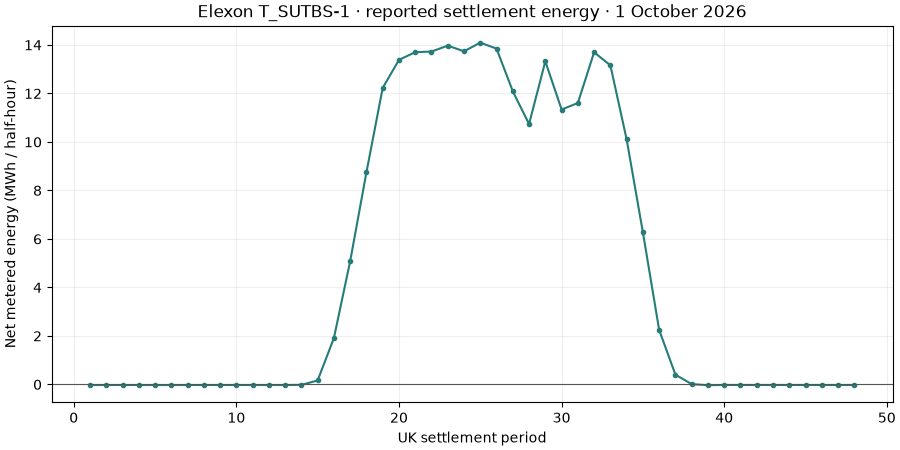
Read a complete 48-period metered day for Elexon BM unit T_SUTBS-1 on
1 October 2026. These are native B1610 MWh per half-hour, including negative
net demand. They are settlement data, not live SCADA. The identifier alone does
not establish the unit’s technology, rated capacity or plant availability.
Source: Elexon B1610 metered-volume explanation.
Download the native response and
capture manifest.
This example runs offline with no API key.
import hashlib
import json
from pathlib import Path

import matplotlib.pyplot as plt

from energy_data_retrieval.sources.elexon import normalize_generation
1. Verify the exact public response#
API access is public. A fresh acquisition, not executed by the gallery:
from datetime import date
from energy_data_retrieval.sources.elexon import ELEXON_HOSTS, ElexonClient
from energy_data_retrieval.transport import HTTPClient
with HTTPClient(ELEXON_HOSTS) as http:
    result = ElexonClient(http).generation(
        date(2026, 10, 1), date(2026, 10, 1), bm_unit="T_SUTBS-1"
    )
directory = (
    Path(globals().get("__file__", Path.cwd() / "plot_generation_elexon.py")).resolve().parent
)
data = directory / "data"
manifest = json.loads((data / "generation_elexon_provenance.json").read_text())
capture = manifest["files"][0]
raw = (data / capture["file"]).read_bytes()
if hashlib.sha256(raw).hexdigest() != capture["sha256"]:
    raise ValueError("Elexon capture differs from its provenance")
print("Source:", capture["source_url"])
print("Retrieved:", capture["retrieved_at_utc"])
Source: https://data.elexon.co.uk/bmrs/api/v1/datasets/B1610/stream?from=2026-09-30T23%3A00Z&to=2026-10-01T22%3A30Z&bmUnit=T_SUTBS-1
Retrieved: 2026-10-30T08:14:32.569242+00:00
2. Preserve settlement periods, revisions and signed quantities#
The parser derives UTC interval starts from UK settlement dates and periods. It handles 46/48/50-period civil days and validates the published UTC end label. Elexon publishes this product after about five working days and revises it through settlement runs. The capture below contains the SF run, not a forecast.
frame = normalize_generation(json.loads(raw))
print(
    frame[
        ["unit_id", "settlement_date", "settlement_period", "value", "unit", "settlement_run"]
    ].head()
)
print("Reported periods:", frame.settlement_period.nunique())
print("Missing quantities:", frame.value.isna().sum())
     unit_id settlement_date  settlement_period  value unit settlement_run
0  T_SUTBS-1      2026-10-01                  1 -0.023  MWh             SF
1  T_SUTBS-1      2026-10-01                  2 -0.023  MWh             SF
2  T_SUTBS-1      2026-10-01                  3 -0.023  MWh             SF
3  T_SUTBS-1      2026-10-01                  4 -0.023  MWh             SF
4  T_SUTBS-1      2026-10-01                  5 -0.024  MWh             SF
Reported periods: 48
Missing quantities: 0
3. Plot native half-hour energy#
Negative quantities remain visible. The source’s generic psrType is not used to assign a fuel. Period labels preserve the civil-day context, and the values are not divided or multiplied by the interval length.
fig, ax = plt.subplots(figsize=(9, 4.5), layout="constrained")
ax.plot(frame.settlement_period, frame.value, color="#257c79", marker=".")
ax.axhline(0, color="#555555", linewidth=0.8)
ax.set(
    xlabel="UK settlement period",
    ylabel="Net metered energy (MWh / half-hour)",
    title="Elexon T_SUTBS-1 · reported settlement energy · 1 October 2026",
)
ax.grid(alpha=0.2)
plt.show()
Interpretation#
Positive and negative intervals can be summarized separately. This is only the selected BM unit and day, not the whole British generation system. No weather-normalized expected-power or performance claim is implied.
print("Positive reported energy (MWh):", frame.loc[frame.value.gt(0), "value"].sum(min_count=1))
print("Negative reported energy (MWh):", frame.loc[frame.value.lt(0), "value"].sum(min_count=1))
Positive reported energy (MWh): 229.59699999999998
Negative reported energy (MWh): -0.552
Total running time of the script: (0 minutes 0.084 seconds)