Note
Go to the end to download the full example code.
South Korea: plan and retrieve hourly regional solar generation#
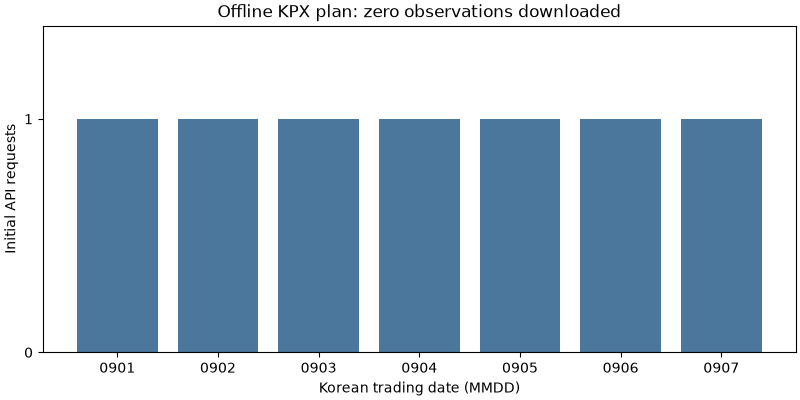
Prepare bounded requests to Korea Power Exchange’s official regional solar generation API. The default example is an offline request plan, not measured or simulated Korean power. It downloads no observations and needs no key.
For actual observations, apply for the official data.go.kr service, set the decoded service key in
KPX_API_KEY locally, and run this script with ENERGY_DATA_INSIGHTS_LIVE=1.
The data covers market-participating solar generators, not all Korean PV. It reports hourly MWh, and can include coupled ESS output. Trading hours 01-24 label hour ends in Korea. Settlement revisions can change prior values.
import os
from datetime import date

import matplotlib.pyplot as plt

from energy_data_retrieval.sources.kpx import KPX_HOSTS, KPXClient, solar_requests
from energy_data_retrieval.transport import HTTPClient
1. Inspect a credential-free bounded request plan#
start, end = date(2024, 9, 1), date(2024, 9, 7)
plans = solar_requests(start, end)
print("First-page plan:", plans[0])
print("Initial daily requests:", len(plans))
print("Further pages, when needed, count against the client's total request limit.")
First-page plan: {'tradeYmd': '20240901', 'pageNo': '1', 'numOfRows': '1000', 'dataType': 'json'}
Initial daily requests: 7
Further pages, when needed, count against the client's total request limit.
2. Fetch only when live access is explicitly enabled#
Keys are passed through the transport’s secret mapping. The returned request records contain public parameters, retrieval timestamps and response hashes.
if os.environ.get("ENERGY_DATA_INSIGHTS_LIVE") == "1":
    with HTTPClient(KPX_HOSTS) as http:
        result = KPXClient.from_environment(http).solar_generation(start, end)
    observations = result.frame
    if observations.empty:
        raise ValueError("KPX returned no observations for this interval")
    pivot = observations.pivot(index="timestamp", columns="area", values="value")
    pivot.plot(
        figsize=(10, 5),
        ylabel="Hourly solar generation (MWh)",
        xlabel="Interval start (UTC)",
        title="Actual market-participating Korean regional solar",
    )
    plt.tight_layout()
    plt.show()
else:
    fig, ax = plt.subplots(figsize=(8, 4), layout="constrained")
    labels = [plan["tradeYmd"][-4:] for plan in plans]
    ax.bar(labels, [1] * len(plans), color="#4b779c")
    ax.set(
        xlabel="Korean trading date (MMDD)",
        ylabel="Initial API requests",
        title="Offline KPX plan: zero observations downloaded",
        ylim=(0, 1.4),
    )
    ax.set_yticks([0, 1])
    plt.show()
3. Interpret the retrieved interval labels#
Hour 01 on 1 September means 00:00-01:00 Asia/Seoul, represented by the UTC interval start 31 August 15:00 and end 16:00. Hour 24 ends at the next midnight. A nighttime value is not automatically erroneous: the source can include ESS. Missing regions/hours remain absent rather than becoming zero generation.
Total running time of the script: (0 minutes 0.051 seconds)